- Location : Home» Newsroom
Independent component analysis deciphers the genetic basis of cotton fiber elongation through eQTLs and sQTLs
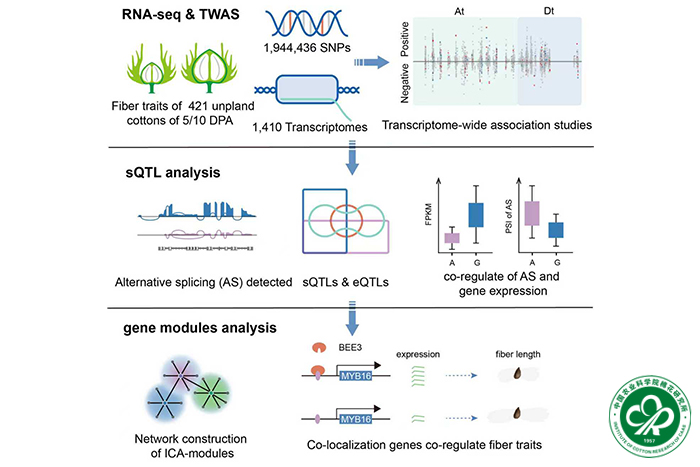
The formation of agronomic traits is regulated by a complex network consisting of transcriptional and post-transcriptional mechanisms. However, the coordination between these regulatory layers in cotton fiber elongation remains poorly understood. Here, we performed a comprehensive analysis of both transcriptional and post-transcriptional regulation for fiber elongation using a population-level transcriptome approach. A total of 50,501 and 53,211 alternative splicing (AS) events were identified at 5 days post-anthesis (DPA) and 10 DPA, respectively. Among these, skipped exon and retained intron events contribute to the protein diversity by modulating the presence of functional domains. These AS events were controlled by 2,930 and 3,116 independent splicing quantitative trait loci (sQTLs) at 5 DPA and 10 DPA, respectively. Although sQTLs and eQTLs independently regulate gene expression, they synergistically control fiber development through independent components analysis (ICA). Notably, FL2, a major fiber length locus, regulates fiber elongation via M103 module. GhMYB16, a M103 module gene, regulates fiber length with expression enhanced by GhBEE3. Our study reveals the genetic basis and regulatory network of fiber development through transcriptional and post-transcriptional mechanisms at the population level, and provides valuable resources for molecular breeding.