- Location : Home» Newsroom
Genome-Wide Identification and Expression Analysis of EBP Genes in Cotton
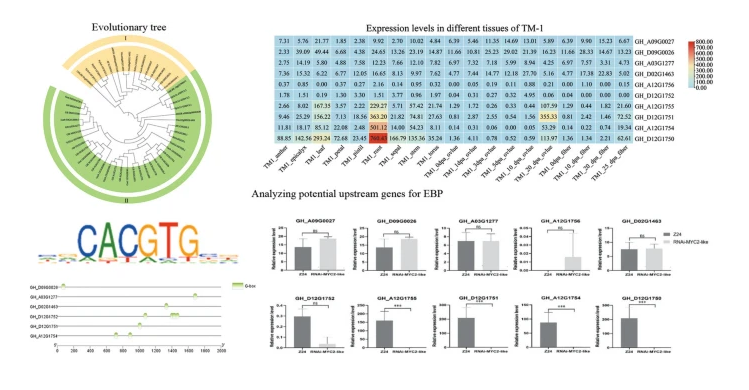
Most cotton varieties of plants have pigment glands that produce and store terpenes. These terpenes play a vital role in the growth and development of cotton. According to the literature, the marker gene of a pigment gland cell cluster, TMEM97 (GH_A12G1754), belongs to the EBP gene family. Promoter element analysis revealed that the promoter of this gene contains multiple G-box elements, so the EBP gene family was analyzed. Emopamil-Binding Proteins (EBP) are integral membrane proteins of the endoplasmic reticulum and catalyze the conversion of Delta(8)-sterols to their corresponding Delta(7)-isomers in cholesterol biosynthesis and Cholesterol metabolism. In this study, the EBP proteins of ten plant species, including 4 cotton species (G. arboreum, G. raimondii, G. hirsutum, and G. barbadense), were identified and their evolutionary relationships and characteristics were analyzed. All EBP proteins localized in the intracellular membrane, possess transmembrane domains, show low hydrophilic and high lipophilic characteristics, and activate under alkaline conditions. Further, 5, 5, 10, and 10 EBP genes were identified in G. arboreum, G. raimondii, G. hirsutum, and G. barbadense, respectively. The EBP gene was found to be expanded in Gossypium by tandem repeats. The evolution of the EBP gene family in Gossypium has mainly underwent purification selection. This suggests that the EBP gene family arose before the differentiation of the genus Gossypium and is conserved during the differentiation of the genus Gossypium. Expression pattern analysis of G. hirsutum EBP genes in different tissues revealed that they function in roots, stems, leaves, ovules and fiber development. Cotton pigment glands contain terpenes and other secondary metabolites. Transcriptome data and fluorescence quantitative PCR analysis revealed that EBP gene family members GH_A12G1755, GH_D12G1751, GH_A12G1754, and GH_D12G1750 were differentially expressed in glanded and glandless cotton, and all of them were low-expressed in glandless lines. According to the literature, GhMYC2-like is a transcription factor known to regulate the formation of pigmented glands. Meanwhile, silencing the expression of GhMYC2-like resulted in a significant decrease in the expression of EBP gene family members GH_A12G1755, GH_D12G1751, GH_A12G1754, and GH_D12G1750. So it is hypothesized that the EBP gene family members may be downstream of GhMYC2-like and involved in the regulation of lipid metabolism in pigment glands. These results provide information for the future study of EBP family genes in cotton.