- Location : Home» Newsroom
Evolutionary Divergence of an Ethylene-Responsive Transcriptional Cascade Governs a Dose-Dependent Balance Between Cotton Fiber Length and Strength
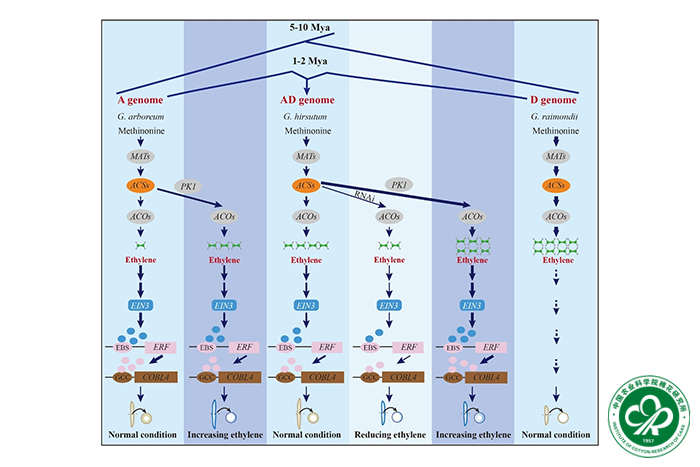
Ethylene is a key hormone in plant development, but how its endogenous levels quantitatively regulate the dose-dependent balance between cotton fiber length and strength has been poorly understood. Here, it is shown that natural variations in ethylene content across Gossypium species (G. hirsutum, G. arboreum, and G. raimondii) correlate with their distinct fiber length and secondary cell wall (SCW) attributes. A post-translational mechanism is identified where a kinase-deficient variant of CASEIN KINASE1 (PK1) stabilizes key ACS1 isoforms to enhance ethylene biosynthesis. In tetraploid cotton (G. hirsutum), elevated ethylene inhibits elongation but promotes SCW deposition, yielding shorter, stronger fibers, while suppressing GhACS1 impairs both processes. Mechanistically, a hierarchical GhEIN3-GhERF-GhCOBL4 transcriptional cascade is uncovered that orchestrates this balance. Remarkably, elevating ethylene in the diploid ancestor G. arboreum elicits the opposite phenotype: longer, thinner fibers. This is explained by a functional inversion in the transcriptional response of the physically conserved cascade, which is activated in G. hirsutum but repressed in G. arboreum. The findings establish a tunable module governing a dose-dependent balance between fiber length and strength, and its evolutionary divergence provides novel targets to break this developmental constraint in cotton engineering.